
How A.A operates as an organisation and how to get involved in service.
“I am responsible. When anyone, anywhere, reaches out for help, I want the hand of A.A. always to be there. And for that: I am responsible.”
This Responsibility Statement was first shared at A.A.’s Fourth International Convention in Toronto in 1965 and has been a guiding principle for A.A. service ever since. In the souvenir book for that Convention, Dr. Jack Norris also wrote, “…We must remember that A.A. will continue strong only so long as each of us freely and happily gives it away to another person, only as each of us takes our fair share of responsibility for sponsorship of those who still suffer, for the growth and integrity of our Group, for our Intergroup activities, and for A.A. as a whole.”

Any A.A. member can get involved in service. It is never too early, or too late in your recovery journey to learn the ways you can contribute. A.A. members who enter the Fellowship are encouraged to attend meetings, join a home group and do service. A.A. members who actively become involved in service not only ensure their own continued sobriety but also that the message continues to be passed on to the still suffering alcoholic. It also ensures the fellowship of Alcoholics Anonymous remains alive and strong.
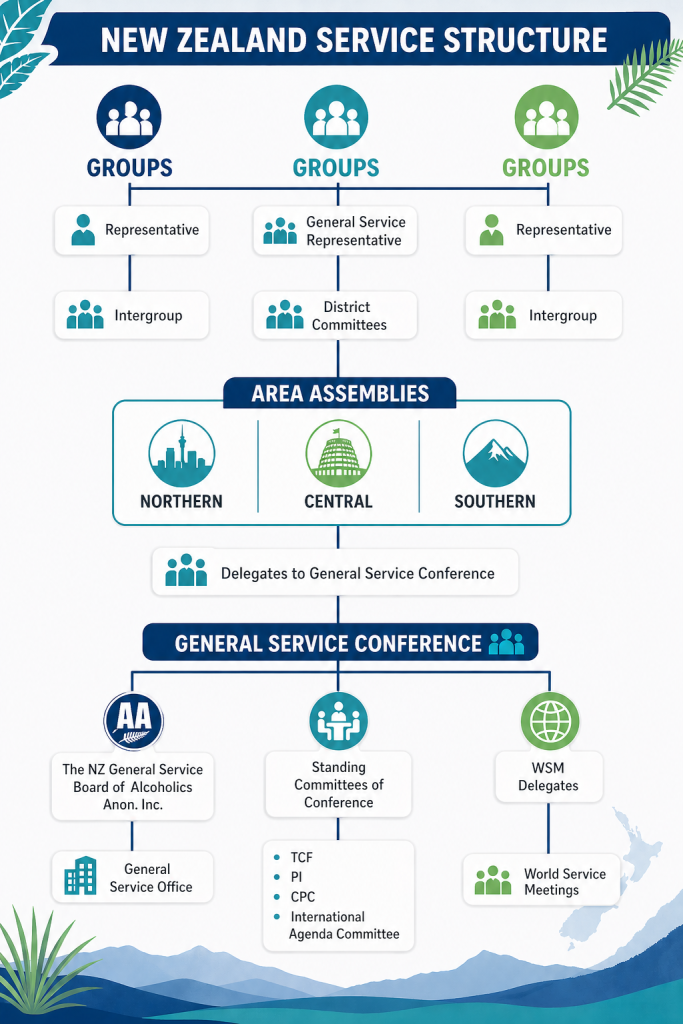
A.A. has a unique, inverted-triangle service structure guided by the Twelve Traditions and Twelve Concepts for World Service. Aotearoa New Zealand’s service structure is split geographically into the Northern, Central and Southern Areas, with each Area electing Delegates to represent them nationally at the New Zealand General Service Conference. Participation from General Service Representatives (GSRs) at Area Assemblies and understanding our service structure is critical for the unity of A.A.
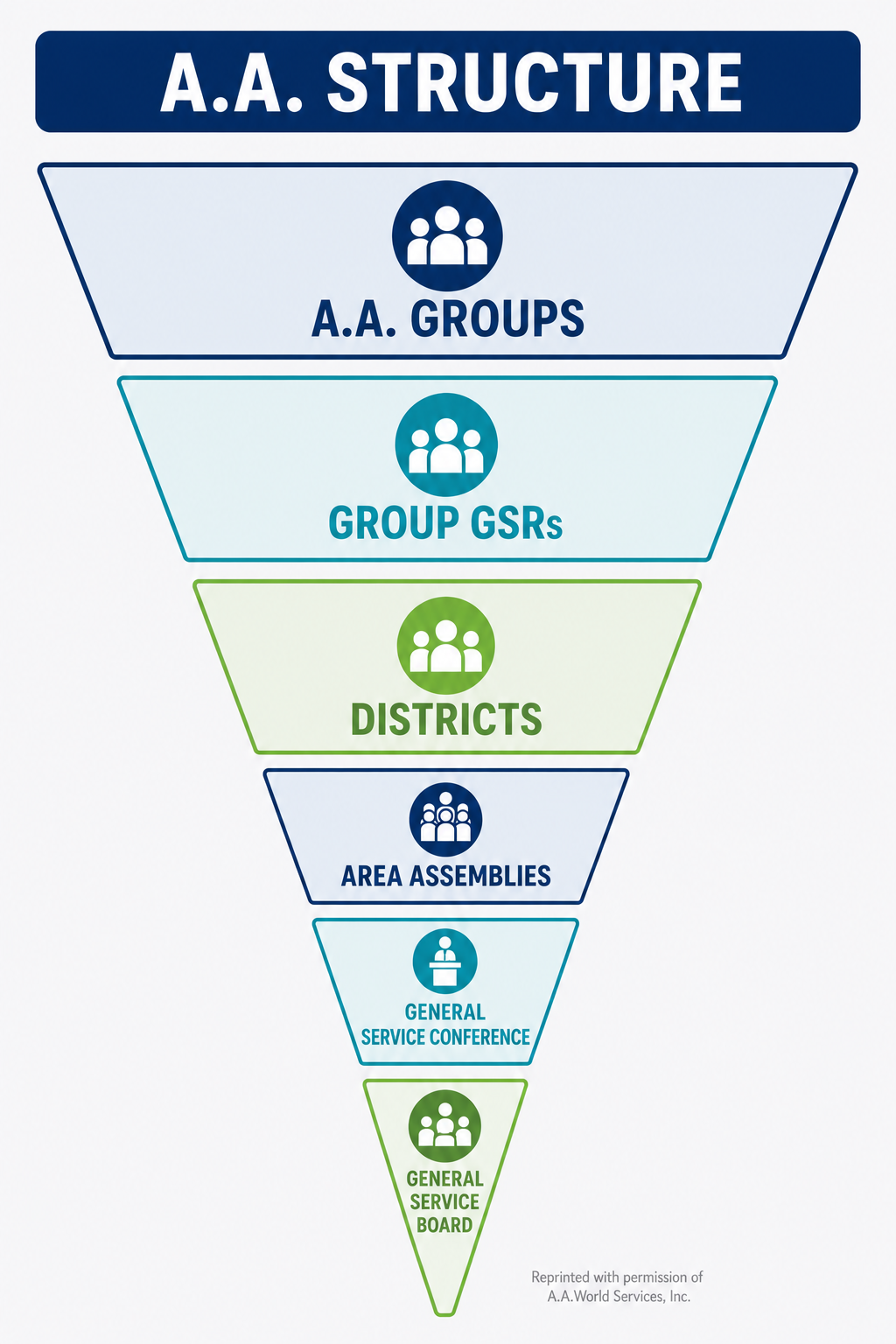
Traditionally, most A.A. members through the years have found it important to belong to one group that they call their “home group.” This is the group where they accept service responsibilities and try to sustain friendships. And although all A.A. members are usually welcome at all groups and feel at home at any of these meetings, the concept of the home group has still remained the strongest bond between the A.A. member and the Fellowship. With membership comes the right to vote on issues that might affect the group and might also affect A.A. as a whole — a process that forms the very cornerstone of A.A.’s service structure. As with all group-conscience matters, each A.A. member has one vote; and this, ideally, is voiced through the home group.
General Service Representative: The group representative is elected by a home group and is their home group’s voting member of the Area Assembly. They are responsible for carrying information between their group to the Area, District Committee, Intergroup, Auckland Service Centre, and the Co-operation with the Professional Community, Public Information, and Treatment & Correctional Facilities Committees.
Treatment & Correctional Facilities (TCF) – Co-ordinate the work of individual members and groups who are interested in carrying our message of recovery to alcoholics in hospitals, alcoholism treatment and rehabilitation centres, and correctional facilities.
Want to learn more? Read the Treatment Committee Workbook or Corrections Workbook or to get involved in Treatment and Correctional Facilities service in Aotearoa New Zealand visit the Doc Store.
Public Information Committee (PIC) – The purpose of Public Iinformation service work is to provide accurate A.A. information to the public when requested. Public Information Committees visit schools, businesses and community meetings for this purpose. They also serve as resources for our friends in the local media, emphasising our Traditions of anonymity, singleness of purpose and non-affiliation, as well as offering A.A. public service announcements to radio and television stations.
Want to learn more? Read the Public Information Workbook.
Co-operation with the Professional Community (CPC) committees provide information about A.A. to those who have contact with alcoholics through their profession. This group includes healthcare, EAP and HR professionals; educators; faith leaders; lawyers; social workers; military professionals; government officials; and those working in the field of alcoholism. Information is provided about where we are, what we are, what we can do, and what we cannot do.
Want to learn more? Read the CPC Workbook
In keeping with the first tradition, a District Committee can serve as a forum where groups have the opportunity to share experience, strength and hope so that they may more effectively solve their problems and address the needs and concerns of the area. An intergroup is made up of a number of groups in a geographic area who get together to discuss A.A. matters in their local area. Intergroups help to co-ordinate 12 step work in their area, support local A.A. groups, and help facilitate connections in their communities.
The Area Assembly provides a vital link in the New Zealand General Service Conference (Conference) structure between the individual A.A. groups and Conference. This communication channel provides a voice through which the fellowship can be heard locally, regionally and nationally on all matters relating to A.A. Delegates are elected by the assembled General Service Representatives (GSRs) which ensures the link between the Conference structure and the groups is strong. It also enables groups in the area to participate in AA worldwide. In Aotearoa New Zealand we have three Area Assemblies – Northern, Central and Southern – which usually meet three times per year.
Anyone can attend an Area Assembly – there are usually general sharing meetings and a public meeting along with the business meeting. Read the Area Assembly Guidelines.
The Conference is the voice of the collective group conscience of Alcoholics Anonymous Aotearoa New Zealand. It is the vehicle by which the fellowship can express its views on all matters affecting A.A. and as such is required to perform such functions as may be directed by the groups through the Area Assemblies.
In Aotearoa New Zealand, the Conference is comprised of nine delegates – three each from Northern, Central and Southern Areas, two World Service Delegates, members from The Board, and Officers of the Conference (Chairperson and Secretary). It does not have a Treasurer, as money goes straight to the General Service Office (GSO) which is accountable to the Board. Conference meets twice a year in April and October.
Want to learn more? Read the Conference Charter.
The Board is an Incorporated Society whose primary function is to serve the General Service Conference. It provides a vehicle for selling A.A. literature, and holds the licences, leases, trademarks, patents, and other property interests, if any (whether intellectual or not), in the name of Alcoholics Anonymous. It promotes awareness activities in relation to Alcoholics Anonymous, controls the management and operation of the General Service Office (GSO); and carries out all instructions from Conference to enable it to achieve its objectives.
In Aotearoa New Zealand The Board is made up of 12 people (including up to 2 Class A non-alcoholics). Members serve a four-year term. Board Members are appointed according to their specialist experience to provide the Board with the necessary skills to carry out its functions and complete the Advisory Actions requested of them by Conference.
Want to learn more? Read the Board Bylaws.
Among other things, their role is to represent Aotearoa New Zealand at the World Service Meeting and Asia Oceania Service Meeting (AOSM) and disseminate and distribute material to the Fellowship. They help keep us connected to A.A. as a whole. A World Service Delegate (WSD) must be a past Area Delegate or General Service Board Member with ten years of continuous sobriety. They serve a four-year term and form part of the Conference. Learn more about becoming a World Service Delegate.

Learn what an A.A. group is; how a group functions; group relations with others in the community; and how the group fits into the structure of A.A. as a whole.
How A.A.s work together to help the alcoholic who still suffers.

An easy to read guide to the Twelve Traditions and suggestions of better ways of working and living.