
How A.A. was established and grew to help over two million people across 180 countries find recovery from alcoholism.
A.A. began in 1935 in Akron, Ohio, when Bill W., a New York stockbroker, met Dr. Bob S., an Akron surgeon – both were struggling alcoholics who had been influenced by the Oxford Group’s spiritual principles. Bill had achieved sobriety with the help of Ebby T. and insights from Dr. William D. Silkworth, who described alcoholism as a disease of mind and body, though he had not yet helped another alcoholic recover. When Bill and Dr. Bob met and shared their experiences, Dr. Bob achieved lasting sobriety, and their partnership marked the founding of Alcoholics Anonymous.
In 1947, the first A.A. meeting was held in Aotearoa New Zealand, bringing the message of recovery to our shores. Today more than 500 meetings are held each week across the motu so that people can find a solution to their drinking problem. Many of us would not be sober today had it not been for the early pioneers who paved the way for us – beginning with Ian MacE., who first wrote to A.A. headquarters in New York in 1946, followed by early members Alf J., Arch F., Howard H., Murdock Y., and Bill L. Though we can never fully repay that debt, we honour their legacy by passing on what was freely given to us to the next sick and suffering alcoholic who walks through our doors.
A.A. began in 1935 in Akron, Ohio, as the outcome of a meeting between Bill W., a New York stockbroker, and Dr. Bob S., an Akron surgeon. Both had been hopeless alcoholics.
Before their meeting, Bill and Dr. Bob had each been in contact with the Oxford Group. This mostly non-alcoholic fellowship emphasized universal spiritual values in daily living. The Episcopal clergyman, Dr. Samuel Shoemaker, led the Oxford Groups in the U.S. at that time.
Under this spiritual influence, and with the help of an old-time friend, Ebby T., Bill had gotten sober. Bill maintained his recovery by working with other alcoholics. Yet, before meeting Dr. Bob, none of these other alcoholics had actually recovered.
At the same time, Dr. Bob’s Oxford Group membership in Akron had not helped him enough to achieve sobriety. When Dr. Bob and Bill finally met, the effect on the doctor was immediate. This time, he found himself face-to-face with a fellow sufferer who was succeeding.
Bill emphasized that alcoholism was a malady of mind, emotions, and body. Bill learned this important fact from Dr. William D. Silkworth of Towns Hospital in New York. Bill had often been a patient of Dr. Silkworth. Though a physician, Dr. Bob had not known alcoholism to be a disease. Responding to Bill’s convincing ideas, Dr. Bob soon got sober, never to drink again. This sparked the founding of A.A.
The book Alcoholics Anonymous, fondly referred to as the Big Book by A.A. members, was first published in 1939. Chapters describing the A.A. recovery program — the original Twelve Steps — and the personal histories of A.A.’s co-founders remain unchanged since the original, while new stories have been added to the personal histories with each edition.
Ian MacE., was the first member of A.A. in New Zealand. He had tried every known treatment for his drinking problem without success. In the latter part of 1945, Ian admitted himself to the Nelson Psychiatric Hospital. It was while in the reading room that he picked up a ‘Reader’s Digest’ magazine and read an article “Maybe you can do it too!” by Edward McG., an alcoholic who had recovered with the help of a Fellowship known as Alcoholics Anonymous. Ian MacE., identified with the article in a way that he had never identified with anyone before. In a footnote to the article, it was suggested that anyone wanting help should write to Alcoholics Anonymous, PO Box 459, New York. On 3 January 1946, Ian wrote to that address and took the first step in his own recovery and AA in New Zealand was born.
The first recorded meeting of two or more sober alcoholics in New Zealand came about in September 1947, in Auckland, when Ian met Lillian Roth and her husband, Burt, from America and later contacted Alf J of Devonport who had become very active in spreading the A.A. message and held meetings in his home and at his dental surgery.
The Devonport Group was the first New Zealand Group registered with the General Service Office, New York, June 1948. Dunedin had in August 1948 two members, Arch F., and Howard H., who were meeting regularly. At the end of 1948 there were six members in New Zealand, Ian MacE., Richmond, Alf J., Auckland, Arch F., Howard H., Murdock Y., Dunedin, and Bill L., Wellington. By 1951 there were six groups in New Zealand, at Auckland, Hastings, Nelson, Wellington, Dunedin and Invercargill, with a total membership of around 60.
On 16 February 1964 at Massey University campus, Palmerston North, the first National Convention of A.A. New Zealand was held. At this Convention, the New Zealand General Service Conference of A.A. was formed. Today, the National Convention is held each January with the location alternating between the three Areas. The General Service Conference meets twice a year, usually in April and October.
In July 1950, Alcoholics Anonymous’ 15th anniversary is marked with an international convention in Cleveland, with some 3,000 people in attendance. One of the most significant events is the adoption of the Twelve Traditions. The convention, held at the Cleveland Public Auditorium, also features the last public message to the Fellowship by Dr. Bob, who stresses, in his brief remarks, kindness and “keeping it simple.”
In 1969 the first World Service meeting was held in New York with two delegates from each of the participating countries in attendance. The second World Service meeting, was also held in New York in 1972. Since then, the meetings are held every two years with locations alternating between New York and some other country. New Zealand, a staunch supporter of World Service, has been represented at all meetings.
A brief history of how the A.A. Fellowship grew, from its beginnings in New York and Akron to its spread around the world.
An account of co-founder Bill W’s tireless work for the Fellowship: the publishing of the Big Book, the development of the Twelve Traditions, the formation of the General Service Conference.
The biography of A.A. co-founder Dr. Bob which includes the rich history of early A.A.
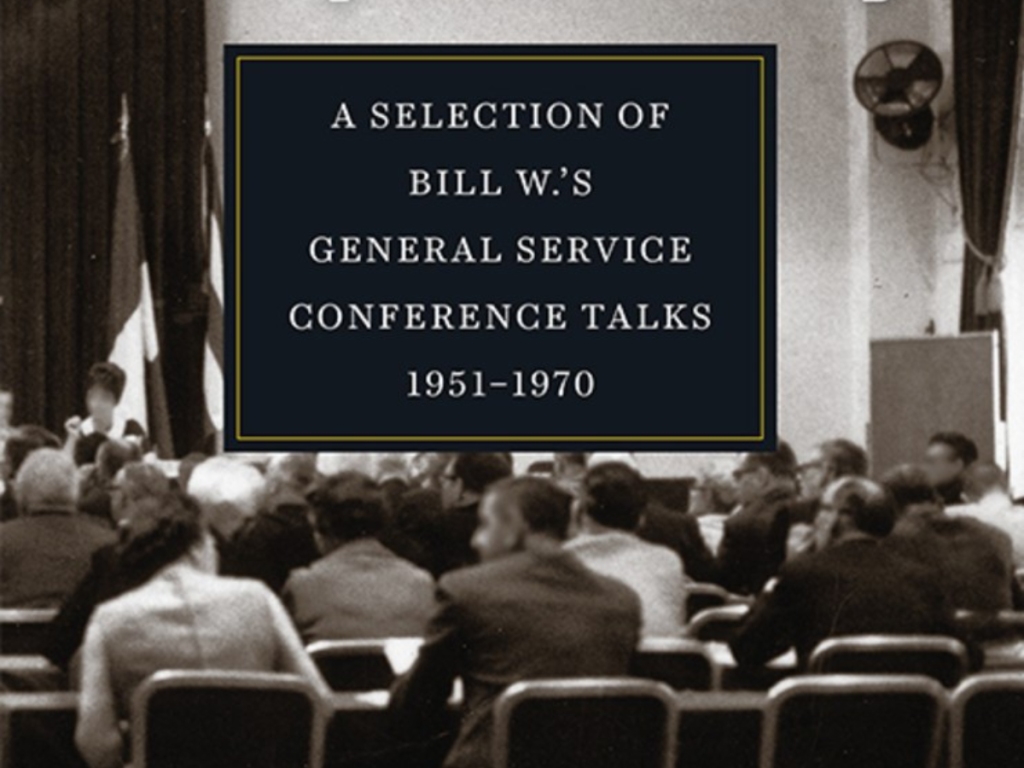
How the General Service Conference was established along with a selection of Bill W.’s General Service Conference talks from 1951 to 1970.